'Statuut' for the Dutch Kingdom
Unknown in the European Netherlands for over 70 years

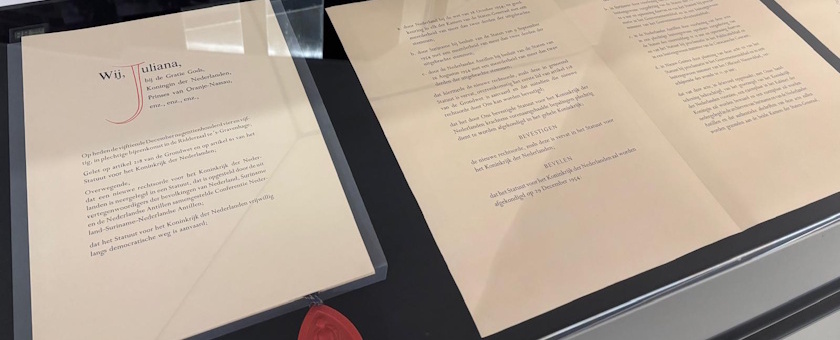
The Charter (locally referred to as the 'Statuut'): The Foundation of a Unique Kingdom
The Kingdom of the Netherlands is unique. It consists of several countries that independently manage their own internal affairs, such as education, healthcare, and infrastructure, while working together on issues that affect everyone: defense, foreign relations, and nationality. These shared responsibilities are known as Kingdom affairs.
On December 15, 1954, the 'Statuut' for the Kingdom of the Netherlands was officially signed. At the time, the Kingdom consisted of the Netherlands, the Netherlands Antilles, and Suriname. The Charter granted each country autonomy over its own governance, while standing above the constitutions and laws of the individual countries. This means that the rules set out in the Charter always come before national laws. The governments of all participating countries played a crucial role in its creation, and Queen Juliana signed as a symbol of unity and continuity, representing the Kingdom as a whole.
A Changing World
In the 1950s, the world was in motion. Countries across Asia and Africa were gaining independence, and across the Caribbean, awareness was growing that the colonial system was a thing of the past. The Netherlands recognized that the old model of "The Hague decides, the islands follow" was no longer sustainable. Something new was needed: a framework of cooperation in which the countries within the Kingdom would be autonomous yet remain connected. Thus, the Charter ('Statuut') was born, a document idealistic in its design, aiming for equal partnership between countries with shared responsibilities in key areas. In practice, this meant greater freedom for the islands without full independence.
Major Changes
Major reforms followed after 1954:
- On November 25, 1975, Suriname gained independence and left the Kingdom.
- In 1986, Aruba obtained a Status Aparte, becoming an autonomous country within the Kingdom.
- On October 10, 2010, the Netherlands Antilles was dissolved. Curaçao and Sint Maarten became autonomous countries, while Bonaire, Saba, and Sint Eustatius became public entities of the Netherlands, similar to special municipalities.
This shaped the modern Kingdom we know today. The 'Statuut' remains its foundation: protecting core values such as human rights, legal certainty, and good governance, ensuring that while each country holds its own powers, they remain united as one Kingdom.
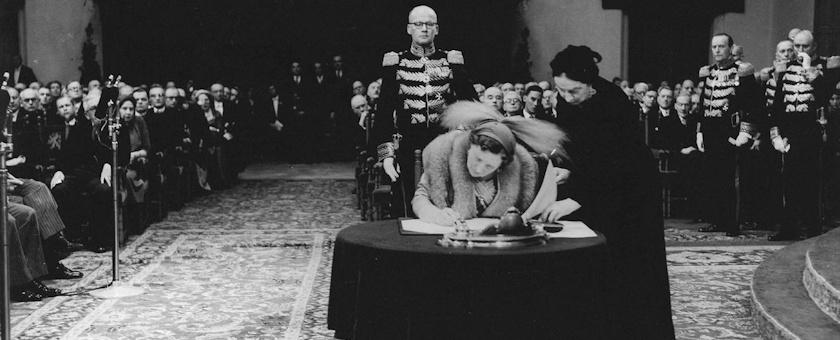
Ideal and Reality
In theory, the Charter was built on equal rights. But equal rights do not mean equal power. The Netherlands has more people, more money, and more influence. The islands are smaller and economically more vulnerable. Although the islands have their own parliament and government, the biggest decisions are still made in The Hague. Because the Netherlands is so much larger, most of the power sits on one side of the ocean. This often leads to friction.
Article 43: Protection or Interference?
An important part of the 'Statuut' is Article 43. It states that the Kingdom must protect human rights, justice, and good government on all islands. That sounds positive, but it also creates tension. Who decides what "good government" is? And when is the Kingdom allowed to step in?
In 2018, for example, the Netherlands took over the local government on Sint Eustatius because The Hague felt the local leaders were failing. The Netherlands saw this as a necessary step. It was legal, but for many islanders, it felt like a step back in time, as if The Hague was playing boss again. Article 43 remains a big debate: is it a shield against bad leadership, or a leftover from colonial times?
The Caribbean View: Equality or Dependence?
For many people in the Caribbean, the 'Statuut' has two sides. Islanders feel frustrated because they have almost no say in decisions made in The Hague that affect their daily lives. On one hand, the Charter offers safety. It protects against corruption and bad management. In times of emergency, like after a hurricane or during financial hardship, the Netherlands provides help.
On the other hand, the 'Statuut' feels like a symbol of dependence because the real power rests in The Hague. This creates a feeling of unfairness: equal on paper, but not in practice.
On Aruba, people are proud of their autonomy and guard strictly against Dutch interference. Curaçao and Sint Maarten often clash with The Hague over financial rules and administrative conditions. And on the BES islands (Bonaire, Saba, and Sint Eustatius), which are special parts of the Netherlands, residents often feel treated like second-class citizens. Their living standards are lower, while everyday prices are higher.
A Heritage with a Future
Discussions about the 'Statuut' are deeply tied to history. Terms like "good governance" sound formal in The Hague, but on the islands, they can feel like distrust and paternalistic behavior. Still, many islanders see the advantages of staying together: stability, safety, access to European support, and a stronger voice in the world.
The 'Statuut' is both a protection and a limitation, a source of pride and frustration. It is not just history; it shapes life today. In every debate about money, schools, or fair rules, it plays a role. It sets the ground rules for what The Hague can do and what the islands must handle themselves.
More than seventy years after the contract was signed, the search for balance continues: between freedom and unity, between ideals and reality. That ongoing balance is what makes this Kingdom so unique.
Bibliography