Saba
The Unspoiled Queen

Saba, the smallest part of the Netherlands
When your plane begins its descent to Saba, it feels like you are flying into an adventure. The small runway, barely four hundred meters long and surrounded by cliffs and ocean, leaves no room for doubt: this island is different from all others. Yet it is precisely this place, the Juancho E. Yrausquin Airport, that symbolizes the strength of Saba. Small, quirky, and built by people who refused to believe that anything was impossible.
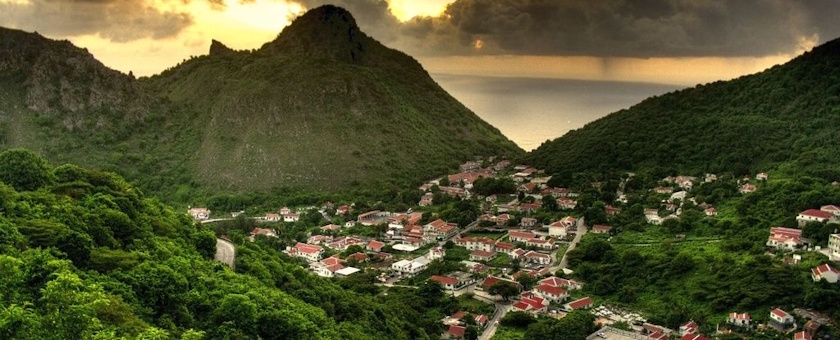
Long before planes could land here, Christopher Columbus saw the island in 1493. He sailed past during his second expedition, named it "San Cristóbal," but never set foot on shore. For centuries, Saba remained a rugged, uninhabited rock in the Caribbean Sea. It was not until the seventeenth century that the first settlers arrived, first Spaniards, then French farmers, English pirates, and finally the Dutch. They founded the village of The Bottom, deep in a green valley, accessible via a steep path full of stones and cliffs.
The population grew slowly, shaped by English, Irish, and Scottish influences. They lived simply, in small houses with thatched roofs built against the mountainsides. Because the island was too small for large-scale agriculture, many men took to the sea. They became fishermen, captains, and sailors who were away from home for months, sometimes years. This is how Saba earned the nickname "The Island of Women," because while the men were sailing, the women kept the island running. They baked bread, wove straw hats, and cared for the children.
The sea was their lifeline, but life on land was hard. There were no rivers, no springs, no waterfalls, only rain. Therefore, the residents built cisterns, stone storage tanks in which rainwater was collected. Anyone who did not have their own cistern had to climb down the mountain to the spring at Spring Bay, climbing back up with heavy containers of water on their heads. It was not until 1920 that the government built three large cisterns for communal use near the church in Hell’s Gate.
The Unspoiled Queen
Despite the difficulties, the people of Saba kept dreaming. In 1943, they began something that everyone considered impossible: a road through the steep mountain landscape. A man named Josephus ‘Lambee’ Hassell followed a correspondence course in road construction, and together with the residents, he laid the first cement road with his bare hands. Fifteen years later, in 1958, all the villages and the harbor were connected, and Saba changed forever.
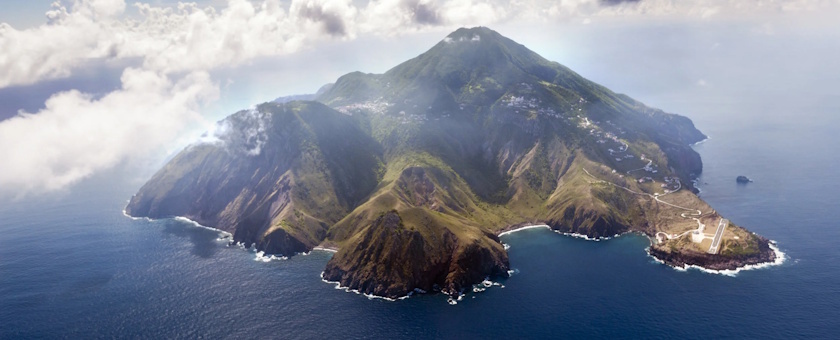
In 1963, the airport of Saba was officially opened. A Frenchman from St. Barth had shown that it was possible to land a plane on the small, steep island. With the support of Minister Juancho E. Yrausquin, an airport was constructed and named after him. The runway was the shortest commercial one in the world, which made the airport a special challenge for pilots. Nevertheless, the opening of the airport meant a major change for Saba: the island became more accessible and the connection with neighbors like Sint Maarten and the rest of the world was significantly improved.
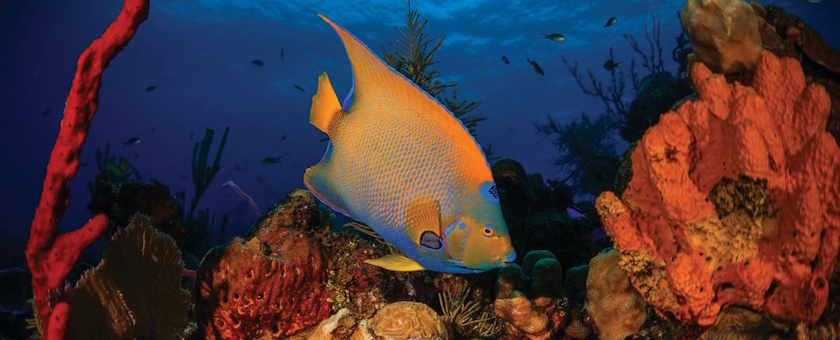
From that moment on, Saba grew slowly, but never at the expense of its pristine nature. In 1987, a foundation was established to protect the island, along with the Saba National Marine Park. The sea, once a source of trade and fishing, now became a paradise for divers. They discovered the colorful reefs around the island, where volcanic rocks transition into beautiful coral reefs. Yet Saba remained true to itself. There were no large hotels, no beaches full of tourists, no noise. Only small family guesthouses, hiking trails through the rainforest, and viewpoints where the clouds sometimes hang lower than you do. Since Saba became a special municipality (BES) of the Netherlands along with Bonaire and Sint Eustatius, Mount Scenery is the highest mountain in our country.
In 1992, something new arrived that changed everything again: the Saba University School of Medicine. Students from all over the world came here to become doctors. They not only gave the island an economic boost but also brought new energy, a connection between tradition and future.
Today, Saba is still what the residents like to call her: "The Unspoiled Queen." An island that has not forgotten its past, but has embraced it. From pirates and sailors to divers and students, Saba tells the story of people who built their own world on a small rock in the middle of the ocean.