The Charter for the Kingdom of the Netherlands
all articles of the charter (locally referred to as the 'Statuut') listed

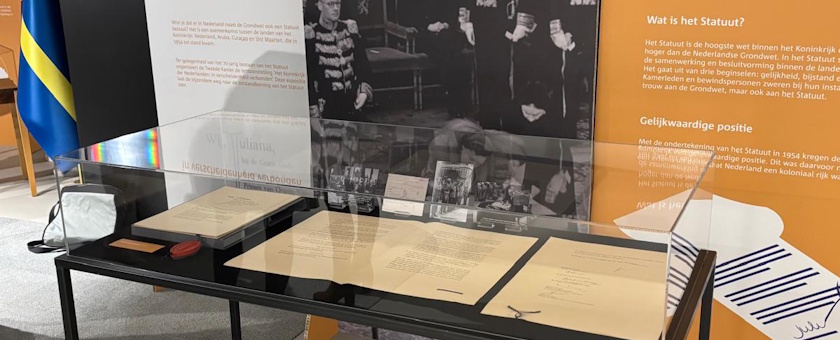
Act of October 28, 1954, containing acceptance of a Charter for the Kingdom of the Netherlands
PREAMBLE
The Netherlands, the Netherlands Antilles and Aruba,
⁕ noting that in 1954 the Netherlands, Suriname and the Netherlands Antilles expressed freely their will to establish a new constitutional order in the Kingdom of the Netherlands, in which they will conduct their internal interests autonomously and their common interests on a basis of equality and will accord each other assistance, and resolved in consultation to adopt the Charter for the Kingdom;
⁕ noting that the ties with Suriname under the Charter were terminated as of 25 November 1975 by means of an amendment to the Charter by Kingdom Act of 22 November 1975, Bulletin of Acts and Decrees no. 617, Official Bulletin of the Netherlands Antilles no. 233;
⁕ considering that Aruba has expressed freely its will to accept the aforesaid constitutional order as a Country;
⁕ whereas Curaçao and Sint Maarten have each declared of their own free will to accept this legal order as a country;
⁕ have resolved in consultation to adopt the Charter for the Kingdom as follows:
§ 1. General provisions
Article 1
The Kingdom comprises the countries of the Netherlands, Aruba, Curaçao, and Sint Maarten.
Article 1a
The Crown of the Kingdom shall devolve by inheritance upon Her Majesty Queen Juliana, Princess of Orange-Nassau, and upon her lawful successors.
Article 2
1. The King shall reign over the Kingdom and over each of the Countries. He shall be inviolable. The Ministers shall be responsible.
2. The King shall be represented by the Governor in the Netherlands Antilles and Aruba. The powers, duties and responsibility of the Governor as representative of the Government of the Kingdom shall be determined by Kingdom Act or, as the case may be, by Order in Council for the Kingdom.
3. Matters pertaining to the appointment and removal of the Governor shall be determined by Kingdom Act. The appointment or removal of the Governor shall be effected by the King as Head of the Kingdom.
Article 3
1. Without prejudice to provisions elsewhere in the Charter, Kingdom affairs shall include:
a. maintenance of the independence and the defence of the Kingdom;
b. foreign relations;
c. Netherlands nationality;
d. regulation of the nationality of vessels and the standards required for the safety and navigation of seagoing vessels flying the flag of the Kingdom, with the exception of sailing ships;
f. supervision of the general rules governing the admission and expulsion of Netherlands nationals;
g. general conditions for the admission and expulsion of aliens;
h. extradition.
2. Other matters may be declared to be Kingdom affairs in consultation. Article 55 shall apply mutatis mutandis.
Article 4
1. Royal power in Kingdom affairs shall be exercised by the King as Head of the Kingdom.
2. Legislative power in Kingdom affairs shall be exercised by the legislative bodies of the Kingdom. Kingdom Bills shall be considered with due observance of the provisions of Articles 15 to 21 inclusive.
Article 5
1. The Monarchy and the succession to the Throne, the Organs of the Kingdom referred to in the Charter, and the exercise of royal and legislative power in Kingdom affairs shall be governed, if not provided for by the Charter, by the Constitution of the Kingdom.
2. The Constitution shall have regard to the provisions of the Charter.
3. Articles 15 to 20 inclusive shall apply to any proposal for amendment of the Constitution containing provisions concerning Kingdom affairs, as well as to the Bill stating the grounds for considering such a proposal.
§ 2. The conduct of Kingdom affairs
Article 6
1. The affairs of the Kingdom shall be managed in cooperation among the Netherlands, Aruba, Curaçao, and Sint Maarten in accordance with the following provisions.
2. Wherever possible the Organs of the Countries shall participate in the conduct of these affairs.
Article 7
The Council of Ministers of the Kingdom consists of the Ministers appointed by the King and the Ministers Plenipotentiary appointed by the Governments of Aruba, Curaçao, and Sint Maarten, respectively.
Article 8
1. The Ministers Plenipotentiary shall act in the name of the Governments of their Countries, which shall appoint or remove them. They must be of Netherlands nationality.
2. The Government of the relevant Country shall provide for a deputy for the Minister Plenipotentiary in the event of absence. The provisions of the Charter with regard to the Minister Plenipotentiary shall apply mutatis mutandis to his deputy.
Article 9
1. Before assuming office the Minister Plenipotentiary shall, in the presence of the Governor, take an oath or make a promise of allegiance to the King and to the Charter. The form of the oath or promise shall be prescribed by Order in Council for the Kingdom.
2. A Minister Plenipotentiary who is in the Netherlands shall take the oath or make the promise in the presence of the King.
Article 10
1. The Minister Plenipotentiary shall participate in the deliberations of the Council of Ministers and of the permanent boards and special committees of the Council whenever Kingdom affairs are discussed which affect the Country in question.
2. The Governments of Aruba, Curaçao, and Sint Maarten are each entitled, if a specific matter gives them cause to do so, to have a minister participate in an advisory capacity in the consultations referred to in the preceding paragraph, in addition to the Minister Plenipotentiary.
Article 11
1. Proposals for the amendment of the Constitution containing provisions relating to Kingdom affairs shall affect Aruba, Curaçao, and Sint Maarten.
2. With regard to defense, it shall be assumed that the defense of the territory of Aruba, Curaçao, or Sint Maarten, as well as agreements or arrangements concerning an area belonging to their sphere of interest, affect Aruba, Curaçao, and Sint Maarten, respectively.
3. With regard to foreign relations, it shall be assumed that foreign relations affect Aruba, Curaçao, and Sint Maarten, respectively, whenever the interests of Aruba, Curaçao, or Sint Maarten are specifically involved, or whenever the provisions made therein may have significant consequences for these interests.
4. The determination of the contribution to the costs referred to in Article 35 affects Aruba, Curaçao, and Sint Maarten, respectively.
5. Proposals for naturalization shall be deemed to affect Aruba, Curaçao, and Sint Maarten only if they concern persons residing in the country concerned.
6. The Governments of Aruba, Curaçao, and Sint Maarten may indicate which affairs of the Kingdom, other than those referred to in paragraphs 1 through 4, affect their country.
Article 12
1. If the Minister Plenipotentiary of Aruba, Curaçao, or Sint Maarten, specifying the grounds on which he expects serious harm to his country, has declared that his country should not be bound by a proposed provision containing generally binding rules, the provision cannot be enacted in such a way that it applies in the country concerned, unless such a course would be inconsistent with the Country's ties with the Kingdom.
2. If the Minister Plenipotentiary of either Aruba, Curaçao or Sint Maarten has serious objections to the initial opinion of the Council of Ministers on the binding nature of the provision referred to in paragraph 1, or on any other matter in the consideration of which he has participated, deliberations thereon shall continue at his request, if necessary having regard to a time-limit to be determined by the Council of Ministers.
3. The deliberations referred to above shall be conducted by the Prime Minister, two Ministers, the Minister Plenipotentiary and a Minister or special representative to be designated by the Government concerned.
4. If multiple Ministers Plenipotentiary wish to participate in the continued consultations, these consultations shall take place between these Ministers Plenipotentiary, an equal number of ministers, and the Prime Minister. Paragraph 2 of Article 10 shall apply mutatis mutandis.
5. The Council of Ministers shall take a decision in accordance with the result of the continued deliberations. If the opportunity for continued deliberations has not been utilized within the time-limit specified, the Council of Ministers shall decide.
Article 12a
By Kingdom Act, provisions shall be made for the settlement of disputes between the Kingdom and the countries, as designated by Kingdom Act.
Article 13
1. There shall be a Council of State of the Kingdom.
2. If the Government of Aruba, Curaçao, or Sint Maarten expresses the wish to do so, the King shall appoint a member to the Council of State for Aruba, Curaçao, and Sint Maarten, respectively, whose appointment shall take place in agreement with the Government of the country concerned. The said member shall not be removed without prior consultation with his Government.
3. The members of the Council of State for Aruba, Curaçao, and Sint Maarten shall participate in the proceedings of the Council of State whenever the Council or a division of the Council is consulted on drafts of Kingdom Acts and administrative Orders in Council of the Kingdom that will apply in Aruba, Curaçao, and Sint Maarten, respectively, or on other matters that affect Aruba, Curaçao, and Sint Maarten, respectively, in accordance with Article 11.
4. Regulations concerning the said members of the Council of State which depart from the Council of State Act may be laid down by Order in Council for the Kingdom.
Article 14
1. Rules concerning affairs of the Kingdom shall—insofar as the subject matter is not governed by the Constitution and subject to international agreements and the provisions set forth elsewhere in the Charter—be established by or pursuant to Kingdom Act. In extraordinary cases of an urgent nature, such rules may be established by an administrative Order in Council of the Kingdom not based on a Kingdom Act or on provisions elsewhere in the Charter, with a maximum period of validity of two years. Upon the expiry of this two-year period, such administrative Order in Council of the Kingdom shall lapse by operation of law.
2. The Kingdom Act or administrative Order in Council of the Kingdom may authorize or delegate the making of further rules to other bodies. Any authorization or delegation to the countries shall be made to the legislature or the government of the countries.
3. Rules concerning affairs of the Kingdom that do not apply in Aruba, Curaçao, or Sint Maarten shall be established by Act of Parliament or administrative Order in Council.
4. Persons resident in Aruba, Curaçao or Sint Maarten shall be naturalized by or pursuant to a Kingdom Act.
Article 15
1. The King shall forward Bills for Kingdom Acts, at the same time as they are introduced in the States-General, to the representative assemblies of Aruba, Curaçao, and Sint Maarten.
2. If a Bill for a Kingdom Act was initiated by the States-General, the Bill shall be forwarded by the House of Representatives immediately following its introduction in the House of Representatives.
3. The Minister Plenipotentiary of Aruba, Curaçao or Sint Maarten shall have the power to propose that the House of Representatives initiate a Kingdom Bill.
Article 16
The representative body of the country in which the regulation will apply is authorized to examine the draft prior to its public debate in the House of Representatives and, if necessary, to issue a written report on it within a period to be specified for that purpose.
Article 17
1. The Minister Plenipotentiary of the Country in which the legislation is to apply shall be afforded the opportunity to attend the debates on the Bill in the States-General and to provide the Houses with such information as he deems desirable.
2. The representative assembly of the Country in which the legislation is to apply may decide to designate, for the purposes of the debate on a particular Bill in the States-General, one or more special delegates who shall likewise be empowered to attend the debates and furnish information.
3. The Ministers Plenipotentiary and the special delegates shall be immune from any legal proceedings in respect of anything they say in or submit in writing to the meetings in the Houses of the States-General.
4. The Ministers Plenipotentiary and the special delegates shall be empowered to propose amendments to a Bill during the proceedings in the House of Representatives.
Article 18
1. The Minister Plenipotentiary of the country in which the regulation will apply shall be given the opportunity to express his views on a proposal for a Kingdom Act prior to the final vote in the Houses of the States-General. If the Minister Plenipotentiary declares himself opposed to the proposal, he may also request the House to defer the vote until the next sitting. If, after the Minister Plenipotentiary has declared himself opposed to the proposal, the House of Representatives passes it by a majority of less than three-fifths of the votes cast, consideration of the proposal shall be suspended and further consultations on the proposal shall take place in the Council of Ministers.
2. When special delegates are present in the sitting of the Houses, the power referred to in the first paragraph shall belong to the delegate appointed for that purpose by the representative body.
Article 19
Articles 17 and 18 shall apply mutatis mutandis to proceedings in joint session of the States-General.
Article 20
Further rules relating to the provisions of Articles 15 to 19 may be laid down by Kingdom Act.
Article 21
If, in the event of war or in other exceptional circumstances in which immediate action is required, the King is of the opinion, after consultation with the Ministers Plenipotentiary of Aruba, Curaçao or Sint Maarten, that it is impossible to await the result of the examination referred to in Article 16, a departure may be made from the provisions of that Article.
Article 22
1. The Government of the Kingdom shall ensure the publication of Kingdom Acts and Orders in Council for the Kingdom, which shall appear in the official bulletin of the Country where the legislation is to apply. The Governments of the Countries shall lend all the assistance necessary to that end.
2. Kingdom Acts and Orders in Council for the Kingdom shall enter into force on the date determined therein or pursuant thereto.
3. The terms of the publication of Kingdom Acts and Orders in Council for the Kingdom shall state that the provisions of the Charter for the Kingdom have been observed.
Article 23
1. The jurisdiction of the Supreme Court of the Netherlands in respect of legal cases in Aruba, Curaçao, and Sint Maarten, as well as on Bonaire, Sint Eustatius, and Saba, shall be regulated by Kingdom Act.
2. If the Government of Aruba, Curaçao or Sint Maarten concerned so requests, the said Kingdom Act shall provide for the addition of a member, an extraordinary member or an advisory member to the Court.
Article 24
1. Agreements with other powers and international organizations that affect Aruba, Curaçao, or Sint Maarten shall be submitted to the representative body of Aruba, Curaçao, and Sint Maarten, respectively, at the same time as their submission to the States-General.
2. If the agreement has been submitted to the States-General for tacit approval, the Minister Plenipotentiary may, within the period set for the Houses of the States-General, express the wish that the agreement be subjected to the express approval of the States-General.
3. The preceding paragraphs shall apply mutatis mutandis to the denunciation of international agreements, with the understanding regarding the first paragraph that notice of the intention to denounce shall be given to the representative body of Aruba, Curaçao, and Sint Maarten, respectively.
Article 25
1. The King shall not bind Aruba, Curaçao, or Sint Maarten to international economic and financial agreements if the government of the country, specifying the grounds on which it expects the binding to be detrimental to the country, has declared that the country should not be bound.
2. The King shall not denounce international economic and financial agreements as far as Aruba, Curaçao, or Sint Maarten is concerned if the government of the country, specifying the grounds on which it expects the denunciation to be detrimental to the country, has declared that no denunciation should take place for the country. Denunciation may nevertheless take place if it is incompatible with the provisions of the agreement to exclude the country from the denunciation.
Article 26
If the government of Aruba, Curaçao, or Sint Maarten expresses the wish for an international economic or financial agreement to be entered into that applies exclusively to the country concerned, the Government of the Kingdom shall cooperate in concluding such an agreement, unless the country's ties within the Kingdom preclude this.
Article 27
1. Aruba, Curaçao, and Sint Maarten shall be involved at the earliest possible stage in the preparation of agreements with other powers that affect them in accordance with Article 11. They shall also be involved in the implementation of agreements that affect them in this way and are binding upon them.
2. The Netherlands, Aruba, Curaçao, and Sint Maarten shall enter into a mutual arrangement concerning cooperation between the countries for the purpose of establishing regulations or other measures necessary for the implementation of agreements with other powers.
3. If the interests of the Kingdom are affected by the lack of regulations or other measures necessary for the implementation of an agreement with other powers in one of the countries, while the agreement can only be ratified for that country once the regulations or other measures are ready, an Order in Council for the Kingdom, or if necessary a Kingdom Act, may specify the manner in which effect is given to that agreement.
4. If the regulations or other measures for the implementation of the agreement in question have been adopted by the country, the Order in Council for the Kingdom or the Kingdom Act shall be repealed.
Article 28
On the basis of international agreements entered into by the Kingdom, Aruba, Curaçao, and Sint Maarten may, if they so wish, accede as members to international organizations.
Article 29
1. The contracting or guaranteeing of a loan outside the Kingdom in the name or for the account of one of the countries shall take place in agreement with the Government of the Kingdom.
2. The Council of Ministers shall concur with the contracting or guaranteeing of such loan, unless the interests of the Kingdom preclude this.
Article 30
1 - Aruba, Curaçao, and Sint Maarten shall render to the armed forces stationed in their territory such aid and assistance as they require in the performance of their duties.
2 - Rules shall be laid down by country ordinance to ensure that the armed forces of the Kingdom can perform their duties in Aruba, Curaçao, and Sint Maarten.
Article 31
1 - Persons resident in the Aruba, Curaçao or Sint Maarten may be compelled to serve in the armed forces or
to perform alternative civilian service only by country ordinance.
2 - The Constitution may determine that persons subject to compulsory service in the army shall be sent
elsewhere without their consent only pursuant to a country ordinance.
Article 32
The armed forces for the defence of Aruba, Curaçao or Sint Maarten shall consist as far as possible of
persons resident within the Country concerned.
Article 33
1 - Requisitioning and use of property, restrictions on title and rights of use, the requisitioning of services
and billeting for defence purposes shall be effected only with due regard to general rules to be laid down
by Kingdom Act, which shall also contain provisions concerning compensation.
2 - Whenever possible the said Kingdom Act shall instruct the authorities of the countries to issue further
provisions.
Article 34
1 - In the event of war or a threat of war or if a threat to or the disturbance of internal peace and order
might seriously damage the Kingdom's interests, the King may, to maintain internal or external security,
declare any part of the territory to be in a state of war or a state of emergency.
2 - How such a declaration shall be made and the ensuing consequences provided for shall be determined
by or pursuant to Kingdom Act.
3 - Such legislation may determine that, and in what manner, powers of the civil authorities in respect of
public order and the police shall be transferred, wholly or in part, to other civil authorities or to the
military authorities and that, in the latter case, the civil authorities shall be subordinate to the military
authorities. Whenever possible the Government of the Country concerned shall be consulted with regard
to the transfer of powers. Such legislation may depart from provisions relating to the freedom of the press
and freedom of association and assembly, and from those relating to the inviolability of dwellings and
correspondence.
4 -. In an area where in the event of war a state of emergency has been declared, military criminal law and
military criminal jurisdiction may be declared wholly or partially applicable to any person, in a manner
determined by Kingdom Act.
Article 35
1 - Aruba, Curaçao, and Sint Maarten shall contribute, in accordance with their financial capacity, to the costs associated with maintaining the independence and the defense of the Kingdom, as well as to the costs associated with the management of other Kingdom affairs, in so far as these serve to benefit Aruba, Curaçao, and Sint Maarten, respectively.
2 - The contribution of Aruba, Curaçao, or Sint Maarten referred to in the first paragraph shall be determined by the Council of Ministers for a financial year or for a number of consecutive financial years.
Article 12 shall apply mutatis mutandis, on the understanding that decisions shall be taken by unanimous vote.
3 - If the determination referred to in the second paragraph does not take place in a timely manner, the contribution established for the last financial year in accordance with that paragraph shall apply pending such determination for a period of no more than one financial year.
4 - The preceding paragraphs shall not apply to the costs of measures for which special provision has been made.
§ 3. Mutual assistance, consultation and co-operation
Article 36
The Netherlands, Aruba, Curacáo and Sint Maarten shall accord one another aid and assistance.
Article 36a
[Expired as of 10-10-2010]
Article 37
1 - The Netherlands, Aruba, Curaçao, and Sint Maarten shall consult with one another as much as possible on all matters in which the interests of two or more of the countries are involved. To this end, special representatives may be appointed and joint bodies established.
2 - The matters referred to in this Article shall include:
a. the promotion of cultural and social relations between the Countries;
b. the promotion of effective economic, financial and monetary relations between the Countries;
c. problems in respect of coinage and currency, banking and foreign exchange policy;
d. the promotion of economic resilience by means of mutual aid and assistance;
e. the conduct of professions and business in the Countries by Dutch nationals;
f. matters relating to aviation, including policy on unscheduled air transport;
g. matters relating to shipping;
h. cooperation in the field of telegraphic, telephone and radio communications.
Article 38
1 - The Netherlands, Aruba, Curaçao en Sint Maarten, may enter into mutual arrangements.
2 - They may decide by common consent that such arrangements and the modification thereof shall be laid down by Kingdom Act or order in council of the Kingdom.
3 - Private law and criminal law matters of an interregional or international nature may be regulated by Kingdom Act, provided that the Governments of the Countries concerned agree to the provisions thereof vertaal in het nederlands
4 - Provision for the transfer of the registered offices of legal persons shall be made by Kingdom Act. Such
provision must be approved by the Governments of the Countries.
Article 38a
The countries may make arrangements by mutual agreement for the settlement of mutual disputes. Paragraph 2 of Article 38 applies.
Article 39
1 - Civil and commercial law, the law of civil procedure, criminal law, the law of criminal procedure,
copyright, industrial property, the office of notary, and provisions concerning weights and measures shall
be regulated as far as possible in a similar manner in the Netherlands, Aruba, Curaçao, and Sint Maarten.
2 - Any proposal for drastic amendment of the existing legislation in regard to these matters shall not be
submitted to or considered by a representative assembly until the Governments in the other countries have
had the opportunity to express their views on the matter.
Article 40
Judgments given and warrants issued by courts in the Netherlands, Aruba, Curaçao en Sint Maarten,and engrossments of authentic acts issued by them, may be enforced throughout the Kingdom, with due
observance of statutory provisions in the Country of enforcement.
§ 4. The constitutional organization of the Countries
Article 41
1 - The Netherlands, Aruba, Curaçao en Sint Maarten shall conduct their internal affairs autonomously.
2 - The interests of the Kingdom shall be a matter of common concern to the Countries.
Article 42
1 - In the Kingdom, the constitutional order of the Netherlands shall be regulated by the Constitution, and that of Aruba, Curaçao, and Sint Maarten by the Constitution of Aruba, the Constitution of Curaçao, and the Constitution of Sint Maarten.
2 - The Constitutions of Aruba, Curaçao, and Sint Maarten shall be established by country ordinance. Any proposal for an amendment to the Constitution shall explicitly state the proposed change. The representative body may pass the draft of such a country ordinance only by a two-thirds majority of the votes cast.
Article 43
1 - Each of the countries shall ensure the realization of fundamental human rights and freedoms, legal certainty, and good governance.
2 - The safeguarding of such rights and freedoms, legal certainty and good governance shall be a Kingdom affair.
Article 44
1 - Any country ordinance amending a Constitution with regard to:
a. articles relating to fundamental human rights and freedoms;
b. provisions relating to the powers of the Governor;
c. articles relating to the powers of the representative assemblies of the Countries;
d. articles relating to the administration of justice,
shall be submitted to the Government of the Kingdom. Such country ordinances shall not enter into effect until the Government of the Kingdom has signified its agreement.
2 - A draft country ordinance concerning the preceding provisions shall not be submitted to the representative body, nor taken into consideration by this body by way of a private member's draft, until the opinion of the Government of the Kingdom has been obtained.
Article 45
Amendments to the Constitution with regard to:
a. articles relating to fundamental human rights and freedoms;
b. provisions relating to the powers of the Government;
c. articles relating to the powers of the representative assemblies;
d. articles relating to the administration of justice,
shall be deemed - without prejudice to the provisions of Article 5 - to affect Aruba, Curaçao en Sint Maarten within the meaning of Article 10.
Article 46
1 - The representative assemblies shall be elected by Netherlands nationals who are residents of the
Country concerned and have attained an age to be determined by the Countries, which should not exceed
25 years. Each voter shall cast only one vote. Elections shall be free and by secret ballot. In case of
necessity the Countries may impose restrictions. Any Netherlands national shall have the right to stand
for election, subject to such requirements of residence and age as the Countries may define.
2 - The Countries may award to Netherlands nationals who are not residents of the Country concerned the
right to vote in elections for the representative assemblies, and to residents of the Country concerned who
are not Netherlands nationals the right to vote and stand in elections for the representative assemblies,
provided in the case of all the foregoing that the requirements for residents who are Netherlands nationals are observed.
Article 47
1 - Before taking office the Ministers and the members of the representative assemblies in the Countries shall swear or promise allegiance to the King and the Charter.
3 - The Ministers and the members of the representative assemblies in Aruba, Curaçao and Sint Maarten shall take the oath, or make the promise, in the presence of the King's representative.
Article 48
The Countries shall take account of the provisions of this Charter in their legislation and administration.
Article 49
Rules may be established by Kingdom Act with regard to the binding force of legislative measures which are inconsistent with the Charter, an international instrument, a Kingdom Act or an order in council for the Kingdom.
Article 50
1 - Legislative and administrative measures in Aruba, Curaçao, and Sint Maarten that are in conflict with the Charter, an international regulation, a Kingdom act, or an Order in Council for the Kingdom, or with interests the care or guarantee of which is a Kingdom affair, may be suspended and annulled by the King as head of the Kingdom by a reasoned decree. The recommendation for annulment shall be made by the Council of Ministers.
2 - This matter shall be regulated for the Netherlands, if necessary, in the Constitution.
Article 51
1 - When an organ in Aruba, Curaçao, or Sint Maarten fails to perform, or inadequately performs, a duty required of it under the Charter, an international regulation, a Kingdom act, or an Order in Council for the Kingdom, an Order in Council for the Kingdom may determine how this shall be provided for, stating the legal grounds and reasons on which it is based.
2 - This matter shall be regulated for the Netherlands, if necessary, in the Constitution.
Article 52
With the assent of the King, a country ordinance may confer upon the King as head of the Kingdom and upon the Governor as an organ of the Kingdom, powers with respect to Country affairs.
Article 53
If Aruba, Curaçao, or Sint Maarten express a desire to that effect, the independent supervision of the expenditure of funds in accordance with the budget of Aruba, Curaçao, or Sint Maarten, respectively, shall be exercised by the General Audit Chamber. In that case, following consultation with the Audit Chamber, rules shall be laid down by Kingdom act regarding the cooperation between the Audit Chamber and the country concerned. The government of the country concerned may then, on the recommendation of the representative body, designate a person who shall be given the opportunity to participate in deliberations on all matters concerning that country.
§ 5. Transitional and final provisions
Article 54
[Rescinded on 17-11-2017]
Article 55
1 - Amendments to this Charter shall be effected by Kingdom Act.
2 - A proposal for amendment adopted by the States General shall not be approved by the King before it has been accepted by Aruba, Curaçao, and Sint Maarten. This acceptance shall take place by country ordinance.
This country ordinance shall not be enacted before the draft has been approved by the Estates in two readings. If the draft is approved in the first reading by a two-thirds majority of the votes cast, the enactment shall take place immediately. The second reading shall take place within one month after the draft has been approved in the first reading.
3 - If and in so far as a Bill for the amendment of this Charter is at variance with the Constitution, the Bill
shall be dealt with in the manner provided for in the Constitution in respect of proposed amendments to the Constitution, with the proviso that in second reading the two Houses may adopt the proposed amendment by an absolute majority of the votes cast.
Article 56
Authorities, binding legislation, ordinances and decrees existing on the date of entry into force of the Charter shall remain in effect until they have been replaced by others pursuant to this Charter. In so far as
the Charter provides otherwise with respect to any matter, the terms of the Charter shall prevail.
Article 57
Acts and Orders in Council that applied in the Netherlands Antilles shall have the status of Kingdom act and Order in Council for the Kingdom, respectively, with the understanding that, in so far as they may be amended by country ordinance pursuant to the Charter, they shall have the status of country ordinance.
Article 57a
Existing Kingdom acts, acts, country ordinances, Orders in Council for the Kingdom, Orders in Council, and other regulations and decrees that are in conflict with an amendment to the Charter shall remain in force until provision has been made therefor with due observance of the Charter.
Article 58
1 - Aruba may declare by country ordinance that it wishes to terminate the constitutional order enshrined in the Charter in respect of Aruba.
2 - A Bill for such a country ordinance shall be accompanied on its submission by an outline of a future constitution, containing in any event provisions on fundamental rights, government, the representative
assembly, legislation and administration, the administration of justice and amendments to the Constitution
3 - The States may only approve such a Bill with a majority of two thirds of the sitting members.
Article 59
1 - Within six months of the approval by the States of Aruba of the Bill referred to in Article 58, a referendum to be regulated by country ordinance shall be held, at which those entitled to vote in elections
to the States may express their opinion on the Bill.
2 - The Bill shall not be enacted as a country ordinance until it has received the approval of a majority of the voters in a referendum.
Article 60
1 - Once the country ordinance has been enacted in accordance with Articles 58 and 59 and once the future constitution has been approved by the States of Aruba with a majority of at least two thirds of the sitting
members, the date on which the government of Aruba feels that the constitutional order should be terminated in respect of Aruba shall be determined by Royal Decree.
2 - This date shall be no more than a month after the constitution has been adopted, which in turn shall be no more than a year after the date of the referendum referred to in Article 59.
Article 60a
1 - The drafts for a Constitution of Curaçao and Sint Maarten, respectively, established by island ordinance by the island councils of Curaçao and Sint Maarten, shall obtain the status of Constitution of Curaçao and Sint Maarten, respectively, at the time of entry into force of Articles I and II of the Kingdom Act amending the Charter in connection with the dissolution of the Netherlands Antilles, provided that:
a. the opinion of the Government of the Kingdom has been obtained before the draft was submitted to the island council concerned, or before a private member's draft was taken into consideration by the island council concerned;
b. the draft was accepted by the island council concerned by at least a two-thirds majority of the votes cast; and
c. the Government of the Kingdom has consented to the draft established by the island council concerned.
2 - If a draft has been accepted by an island council by a majority smaller than two-thirds of the votes cast, the condition referred to in paragraph 1, under b, is met if the island council is dissolved after the vote on the draft and the draft is accepted by an absolute majority of the votes cast by the newly elected island council following that dissolution.
3 - If a draft has been accepted by an island council by a majority smaller than two-thirds of the votes cast and the island council concerned has not been dissolved, that island council shall be dissolved by the Lieutenant Governor. The decree of dissolution shall include the calling of an election for a new island council within two months and the first meeting of the new island council within three months after the date of the decree of dissolution. If the newly elected island council accepts the draft by an absolute majority of the votes cast, the condition referred to under b of paragraph 1 is met.
Article 60b
1 - The draft country ordinances of Curaçao and Sint Maarten, respectively, established by island ordinance by the island councils of Curaçao and Sint Maarten, shall obtain the status of country ordinances of the country of Curaçao and Sint Maarten, respectively, at the time of entry into force of Articles I and II of the Kingdom Act amending the Charter in connection with the dissolution of the Netherlands Antilles.
2 - The draft national decrees and draft national decrees containing general administrative measures, respectively, established by island decree or island decree containing general administrative measures by the Executive Council of Curaçao or Sint Maarten, shall obtain the status of national decree and national decree containing general administrative measures, respectively, of Curaçao and Sint Maarten, at the time of entry into force of Articles I and II of the Kingdom Act amending the Charter in connection with the dissolution of the Netherlands Antilles.
Article 60c
The Executive Councils of Curaçao and Sint Maarten may enter into draft mutual regulations with each other and one or more governments of the countries of the Kingdom, which shall obtain the status of mutual regulations within the meaning of Article 38, paragraph 1, at the time of entry into force of Articles I and II of the Kingdom Act amending the Charter in connection with the dissolution of the Netherlands Antilles.
Article 61
The Charter shall enter into force at the time of its solemn proclamation, after it has been confirmed by the King.
Before confirmation takes place, the Charter requires acceptance for the Netherlands in the manner provided for in the Constitution; for Suriname and for the Netherlands Antilles by a resolution of the representative body.
This resolution shall be passed by a two-thirds majority of the votes cast. If this majority is not obtained, the Estates shall be dissolved and a decision shall be taken by the new Estates by an absolute majority of the votes cast.
Article 62
[Rescinded.]